Your hygienist could be your best friend - a new dementia study explains why
Bleeding gums are one of the most common things patients mention to us - and one of the most commonly ignored. A study published in September 2026 suggests they may deserve more attention than they get, not just for your mouth but for your long-term brain health. And it makes a strong case for someone you may not see often enough: your dental hygienist.
What the researchers did
Researchers in Japan followed 1,396 adults aged over 60 for ten years. None of them had dementia when the study began. The team assessed their gum health at the start and then tracked who went on to develop dementia over the following decade.
By the end of the study, 267 participants had developed dementia, and 194 of those were diagnosed with Alzheimer’s disease.
What they found
The results, published in the Journal of Clinical Periodontology and reported by The Independent, show a clear pattern:
- Participants with the most severe gum bleeding were 54% more likely to develop dementia over the ten years than those with healthy gums
- The same group were 61% more likely to develop Alzheimer’s disease specifically
- Those with the worst gum recession had a 59% higher risk of dementia
Gum bleeding was present in the majority of people who went on to be diagnosed with Alzheimer’s.
An important word of caution
This was an observational study. It shows a link between gum disease and dementia - it does not prove that one causes the other. The researchers themselves point out that all the participants came from a single town in Japan, so the findings need confirming in larger and more diverse groups before firm conclusions can be drawn.
It is also possible that gum disease and dementia share a common root cause rather than one driving the other. The leading theory is chronic inflammation. Gum disease is a persistent bacterial infection, and the researchers suggest that long-running inflammation throughout the body may weaken the barrier that protects the brain, allowing inflammatory chemicals to reach brain tissue and damage nerve cells over time.
Either way, this study adds to a growing body of research - including a large UK Biobank study earlier this year - that keeps finding the same connection between the mouth and the brain.
Where your hygienist comes in
The encouraging news is that gum disease is preventable and, in most cases, very treatable. The researchers specifically suggest that periodontal care to improve and maintain gum health may help lower dementia risk - and periodontal care is exactly what a hygienist does.
Here’s why regular hygienist visits matter so much:
- They remove what you can’t. Once plaque hardens into tartar, no amount of brushing will shift it. A hygienist cleans it away, especially below the gum line where gum disease takes hold.
- They spot trouble early. Hygienists measure your gums at every visit, so they can catch bleeding, pocketing and recession long before you’d notice anything yourself.
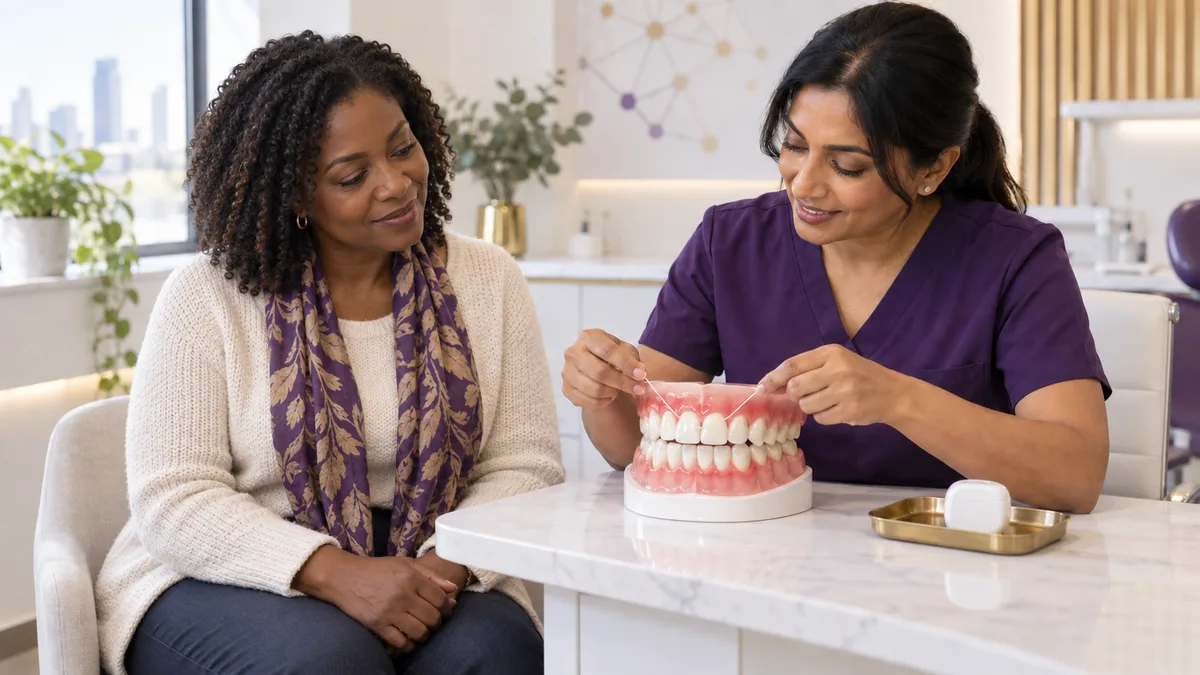
- They tailor advice to your mouth. Everyone’s teeth are different. A hygienist can show you exactly where you’re missing and which interdental brush sizes actually fit your gaps.
- They keep you on track. Gum disease is a long-term condition, and regular visits are what stop it creeping back.
What you can do between visits
- Brush twice a day for two minutes with a fluoride toothpaste, angling the brush towards the gum line
- Clean between your teeth every day with interdental brushes or floss - this is where gum disease usually starts
- Treat bleeding as a warning sign, not something normal - healthy gums don’t bleed when you brush
- Don’t stop brushing an area because it bleeds; the bleeding usually settles once the gums are clean again
Book a hygienist visit at William Place
We’ve been caring for families in Bow since 2008, and gum health is at the heart of what we do. If your gums bleed when you brush, feel tender, or seem to be receding - or if it’s simply been a while since you last saw a hygienist - we’d be glad to see you.
Call us on 020 8821 2830 or visit us at 12 William Place, Bow, London E3 5ED to book an appointment.
This post is for general information and is not a substitute for individual advice from your dentist or doctor.