Teeth grinding is having a moment — here's what actually helps

Teeth grinding made the news this month — the BBC reported that dentists across the UK are seeing more of it, particularly in younger patients, with some studies suggesting nearly one in four people have bruxism. The detail that surprises most people: the majority don’t know they’re doing it until the damage, or the pain, shows up.
We see this in our own chairs in Bow every week. So here’s the honest guide — what bruxism is, how to tell if you’re doing it, why it happens, and what genuinely helps (with our real prices, because that’s how we do things).
What is bruxism?
Bruxism is the umbrella term for clenching, grinding, bracing or thrusting the jaw. Some people do it at night — often loudly enough to wake a partner — others clench silently at a desk all day. Neither is a character flaw: it’s your nervous system working your jaw muscles, usually without asking permission.
The signs you’re grinding — even if you’ve never noticed
- Waking with an aching jaw, temples or a dull headache — the classic morning giveaway
- Teeth that look flatter, shorter or chipped at the edges, or fillings that keep breaking
- New sensitivity to hot and cold, as enamel thins
- A partner who’s heard it — night grinding can be surprisingly loud
- A squarer jawline developing over time — constantly exercised jaw muscles (the masseters) grow, like any muscle
- Scalloped tongue edges or bite marks inside the cheeks
- Unrefreshing sleep — sometimes a clue that something bigger is going on
Two or more of those and it’s worth mentioning at your next check-up — we can see wear patterns on your teeth long before you’d spot them in a mirror.
Why it happens — stress, and sometimes your airway
The link most people intuit is real: stress and anxiety put the body in fight-or-flight, and because the jaw is wired so directly into the nervous system, the tension often lands there. Therapists quoted in the BBC’s report describe clients tracing their grinding straight back to the most stressful periods of their lives.
But there’s a second cause worth taking seriously: obstructive sleep apnoea. When the airway narrows during sleep, grinding can be the body’s way of pushing the jaw around to reopen it. That’s why handing out a mouthguard without asking why someone grinds isn’t good enough — if snoring, gasping or heavy daytime tiredness sound familiar alongside the grinding, the airway question comes first. It’s an area we know well: we provide the Sleepwell™ mandibular advancement splint for snoring and mild to moderate sleep apnoea, which holds the airway open overnight — and as a side benefit it keeps the teeth apart, so it can ease grinding symptoms too.
What actually helps
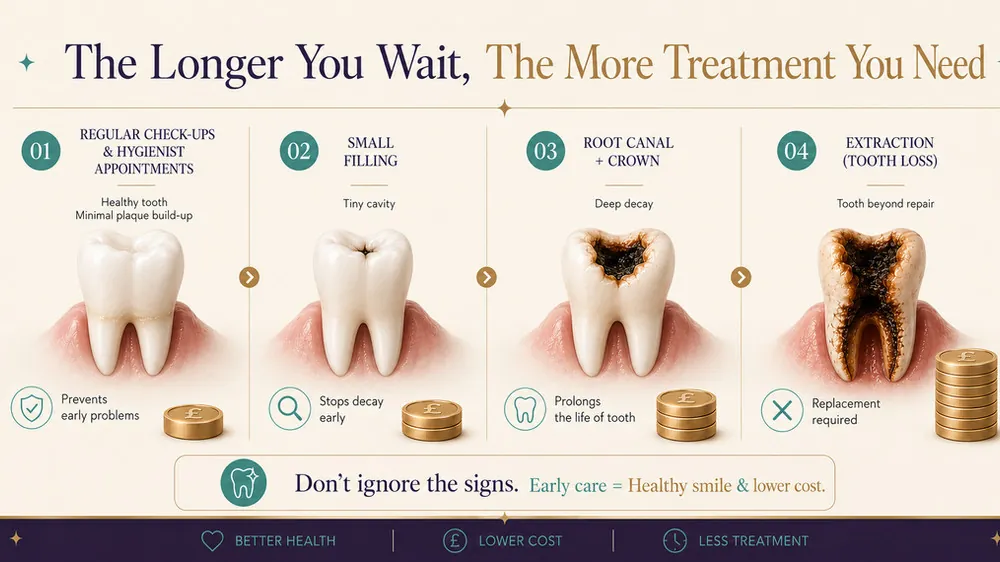
1. Get it seen early. A comprehensive oral health assessment — £54, or £35 off-peak, including X-rays — is where grinding usually gets caught. Repairing teeth worn down over years can run into thousands; catching it early costs a check-up.
2. Protect the teeth. A custom-made guard absorbs the forces instead of your enamel — a soft mouthguard is £205, a hard biteguard £314, both made to fit your mouth precisely. Honest caveat from the news coverage, which we’d echo: a guard protects teeth, it doesn’t cure the grinding.
3. Address the cause. If it’s airway-related, the Sleepwell splint above treats the actual problem. If it’s stress — and it often is — we’ll say so plainly: the dental side protects your teeth while you deal with the pressure itself, whether through your GP, talking therapy or the unglamorous basics of sleep and exercise.
4. Relax the muscles themselves. For heavy grinders with enlarged, aching jaw muscles, muscle-relaxing injections into the masseters reduce the tension (and, over time, the squared jawline) — the treatment the BBC’s case study called life-changing. We offer masseter jaw reduction at £456, delivered by our clinicians — and on that subject, we’ve written before about why injectables belong in clinical hands.
5. Repair the damage. Worn edges can often be rebuilt with composite bonding in a single visit; more heavily worn or cracked teeth may need crowns. Both are routine work for us, with every price published upfront.
One reassurance
The researchers in the BBC’s report make a point we’d echo: bruxism isn’t always the villain. Jaw movement stimulates saliva, which protects teeth, and mild grinding often comes and goes with life’s pressure. The time to act is when there’s pain, visible wear, broken dental work, or poor sleep — those don’t fix themselves.
If any of this sounds like your mornings, book an assessment or call 020 8821 2830 — we’re an independent, female-led practice in Bow, East London, and we’ll tell you straight which of the above you need, and which you don’t.