Preventive Dental Treatment: Why Dentists Act Before You Feel Pain
One of the most common things we hear at William Place Dental Aesthetics is some version of: “It’s not hurting me, so why do I need to do anything about it?”
It’s a fair question - and an understandable one. If nothing hurts, surely nothing’s wrong? Unfortunately, that’s one of the biggest misunderstandings in dentistry, and it’s worth explaining why.
Pain is a Late Warning Sign, Not an Early One
Teeth don’t have many nerve endings on their outer surfaces. The nerve sits deep inside, protected by enamel and dentine. That means decay, cracks, or a failing filling can quietly progress for months - sometimes years - before you feel anything at all.
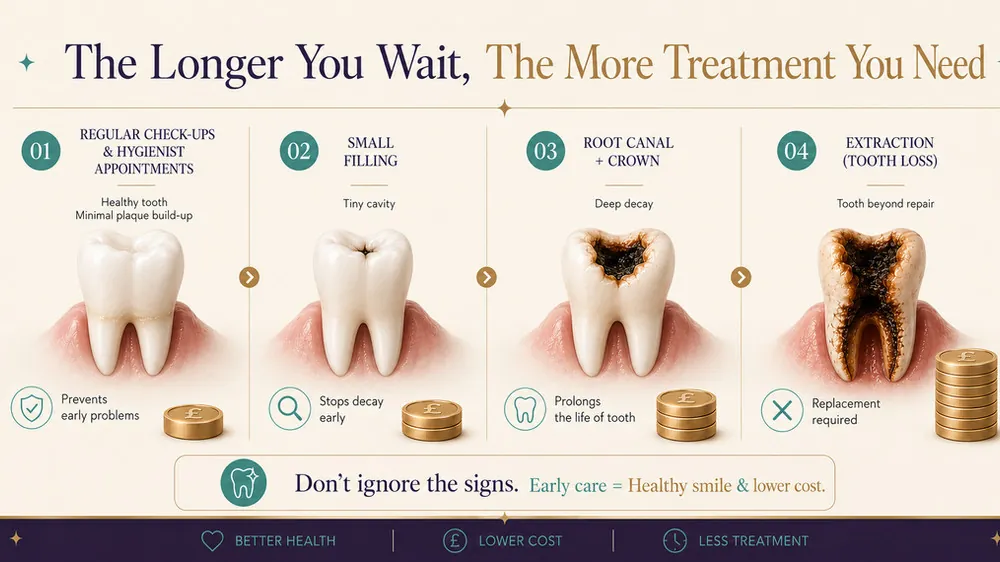
By the time a tooth actually hurts, the problem has often already reached the nerve, or come close to it. At that stage, the options are usually more invasive, not less:
-
A small, early filling can often fix decay caught early.
-
A larger filling or crown may be needed if it’s progressed further.
-
Root canal treatment becomes necessary once decay or infection has reached the nerve.
-
Extraction may be the only option if the tooth is too badly damaged to save.
In other words, waiting for pain doesn’t avoid treatment - it just means the treatment you eventually need is bigger, more expensive, and takes longer to recover from.
Why Old Fillings Get a Second Look
The same logic applies to older fillings, even ones that feel perfectly fine. Fillings don’t last forever. Over years of biting, chewing, and temperature changes, the material can develop microscopic cracks or start to pull away slightly from the tooth at the edges.
When that happens, bacteria can find their way underneath the filling - somewhere you can’t see and, crucially, somewhere you usually can’t feel until it’s gone quite far. This is sometimes called secondary or recurrent decay, and it’s one of the most common reasons old fillings eventually fail.
Checking older fillings isn’t about finding problems for the sake of it. It’s about catching that kind of hidden decay while it’s still small enough to fix simply, rather than after it’s spread far enough to cause pain - at which point the tooth may need much more extensive work.
A Filling or Crown Isn’t a Permanent Fix
It’s also worth clearing up another common assumption: once a tooth has been treated - whether that’s a filling, a crown, or any other restoration - it isn’t then “done” for life. Having work done on a tooth doesn’t make it immune to future problems.
The mouth is a dynamic environment. It changes constantly - through daily wear, grinding, diet, gum changes, and simply the passage of time. Restorations are subject to the same forces as natural teeth, and in some ways more so, because the join between a restoration and the natural tooth is often where problems start. A filling can crack, wear down, or start to leak at the edges. A crown can loosen, or decay can develop underneath it, out of sight.
This is exactly why previously treated teeth are checked at ongoing appointments, not just left alone because “it’s already been fixed.” A tooth with a restoration still needs the same attention as any other tooth - arguably more, since a failing restoration can hide problems until they’ve progressed significantly.
For teeth with existing restorations, ignoring these early signs doesn’t make them go away - it gives them time to develop into more significant problems. Left long enough, decay or damage around an old filling or crown can progress to the point where the tooth can no longer be saved with a repeat restoration, and extraction becomes a very real possibility.
Restorations Extend a Tooth’s Life - They Don’t Reset It
It’s worth being clear about what a filling, crown, root canal treatment, or any other restoration is actually doing. None of these treatments turn back the clock on a tooth. What they do is extend the working life of that tooth for as long as possible, by repairing or containing the damage that’s already there.
How long any individual restoration lasts isn’t a fixed number - it depends on a mix of factors, including the size and location of the restoration, the material used, how the tooth is used day to day (grinding or clenching, for example, puts far more strain on a restoration than normal biting), oral hygiene, diet, and simply how that particular tooth and patient respond over time. Two people with what looks like an identical filling can get very different lifespans out of it.
This is part of why ongoing monitoring matters, even for teeth that have already been treated. A restoration isn’t a one-off transaction that closes the file on that tooth - it’s an ongoing part of your dental health that, like the rest of your mouth, benefits from being kept an eye on.
Preventive Dental Treatment Isn’t a Sales Tactic - It’s the Whole Point of Dentistry
We understand that any recommendation for preventive dental treatment can feel, from the outside, like it might be more about the practice than about you. We’d rather be upfront about our thinking than leave that gap for you to fill in yourself.
The honest answer is this: the entire purpose of regular dental check-ups is preventive dental treatment - finding problems before they become painful, expensive, or urgent. If we only ever treated things once they hurt, check-ups would be pointless - you’d just come in when something already felt wrong.
Catching things early is not just better for your comfort. It’s also almost always better for your wallet and your time, because early treatment tends to be smaller, cheaper, and quicker than late treatment.
This Isn’t About “Targets” or “Corporate Greed”
It’s an easy assumption to make: a dentist recommends treatment, and it’s tempting to wonder whether that’s really about your tooth, or about the practice’s bottom line. We understand why that thought comes up - but it’s worth addressing directly.
William Place Dental Aesthetics is an independent, privately owned practice. We are not part of a corporate chain, and our dentists are not working to sales targets or quotas. There is no incentive structure here that rewards a dentist for recommending treatment you don’t need.
What does drive our recommendations is simple: clinical judgement, based on what we can see in your mouth and what we know happens to teeth over time. A dentist who tells you about a problem before it becomes painful isn’t trying to extract more from you - they’re doing the job properly. The alternative - staying quiet about something we can see forming, and letting you find out the hard way - would be a failure of care, not a kindness.
If a recommendation ever feels unclear or unjustified, please ask us to explain it. We would always rather talk it through than leave you wondering about our motives.
What to Ask Instead
If a dentist recommends treatment and you’re not sure why, the most useful question isn’t “is it hurting me?” - it’s:
-
“What will happen if I leave this?”
-
“How likely is this to get worse, and how quickly?”
-
“What would treating it now involve, versus treating it later?”
A good dentist should be able to answer all three clearly, and should never mind being asked. That conversation - not just the recommendation itself - is what lets you make an informed decision about your own care.
If you have questions about a treatment recommendation, current or past, we’re always happy to talk it through. Get in touch with William Place Dental Aesthetics, 12 William Place, Bow, London E3 5ED, on 020 8821 2830.
Tags:
-
Bow dental
-
Bow East London dentist
-
natural looking smile
-
cosmetic dentistry
-
dental care
-
dental fillings
-
William Place Dental Aesthetics
-
dental hygienist
-
silver fillings
-
gum disease
-
Roman Road dentist
-
dental emergency
-
east london dentist